

Many individuals, even some financial advisors, possess an uninformed or incorrect understanding of what “risk” really entails in the context of investing.
We often misinterpret risk and it can have severe implications.
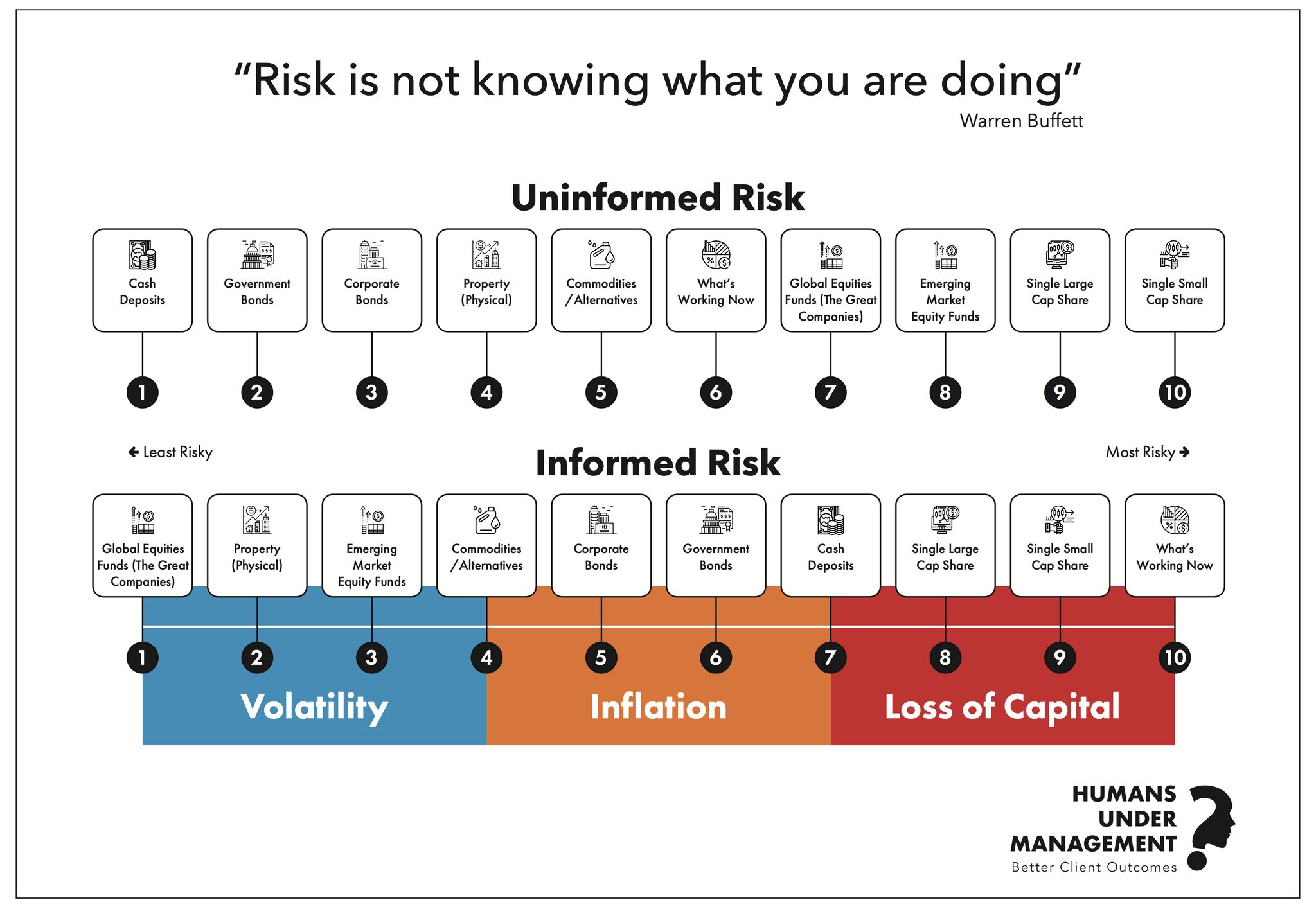
The image below is a scale of risk – better known as the informed risk scale. It seeks to, distinguish between informed and uninformed perceptions of risk.
Let’s start with volatility
Many individuals confuse market volatility with risk. Volatility is the short-term fluctuation in the value of investments, while risk is more accurately related to the likelihood of permanent loss or the failure to meet financial goals. This misunderstanding can lead investors to make poor investment decisions during market downturns, such as selling off assets at a loss out of fear. Or take a person who perceives market volatility as an unbearable risk. They might insist on overly conservative investments that do not keep pace with inflation, thus endangering their financial future.
Traditional financial advice often fails to consider the psychological elements that influence investing. Many financial missteps are due to psychological biases rather than informational shortcomings. For instance, the ‘recency bias’ leads people to expect that recent occurrences (like a market downturn) will continue to happen, causing irrational fear or optimism.
Then there’s the risk of not achieving financial goals
Individuals often overlook this fundamental risk. The real risk is not short-term fluctuations in the market but rather the possibility that a financial strategy may not align with an individual’s or family’s long-term goals. It’s imperative to focus on strategic planning over tactical moves influenced by market conditions.
Then there are behavioural biases
Behavioural biases significantly contribute to misinterpretations of risk. Biases such as loss aversion, where we can be more sensitive to losses than to gains, can skew the perception of risk and lead to bad decision-making. It’s important to develop a more sophisticated understanding of what risks are relevant to your unique situation and how to manage them effectively.
Use the Informed Risk Scale as a tool to help rectify these misunderstandings, It’s a conceptual framework aimed at helping investors to understand and navigate the complexities of risk in investing.
Do you recognise any behavioural biases in your own investing decisions?
Benefit from comprehensive, integrated, and objective advice.
Let’s discuss your specific needs and how I can help you meet your objectives
Let’s start the conversation
Online enquiry form
Related posts
 Published On: September 18, 2026|5.4 min read|
The Risk Hiding in the ‘Safe’ Part of Your Portfolio
Your pension may hold more gilts than you realise. How the bond market prices government borrowing, and why "safe" is not the same as free from risk.
Read more
 Published On: September 11, 2026|7.9 min read|
Six Funds. One Portfolio. More Overlap Than You Think.
This is one of the things you notice when you spend enough time looking through investment portfolios. People often own the same companies far more times than they realise. It doesn't make those companies bad investments. It does mean the number of funds in your portfolio tells you almost nothing about how diversified you really are.
Read more
 Published On: June 24, 2026|6.6 min read|
UK State Pension Abroad: Frozen Pensions, National Insurance Changes and What Expats Need to Know
Recent changes to voluntary National Insurance contributions, frozen pension rules and the hidden risks facing expatriate families.
Read more