Market Response
The market response to Labour winning the election was pretty calm, with minimal financial market ripples. The lack of movement was unsurprising given the overall result had already been priced in.
Potential Changes
Labour made several commitments during their campaign, including sticking with the pension triple lock and ruling out rises in income tax, National Insurance, or VAT. However, there are still potential tax changes looming post-election, with rumors swirling about possible tax hikes. Income tax thresholds, ISA allowances, inheritance tax, and capital gains rates are all under scrutiny.
Pensions
We await Labour’s pension review to gain more clarity in this area. Making tax relief on pensions less generous could be an option. The 2024/25 annual allowance for paying into a pension without incurring tax is £60,000. Labour’s decision not to reintroduce the lifetime allowance has been welcomed.
ISAs
Another Conservative policy that Labour will have to tackle is the UK ISA, which promises another £5,000 ISA allowance but is ring-fenced for investments in UK companies. Labour didn’t make any mention of it in their manifesto and said it has ‘no plans’ to scrap the policy, although it hasn’t explicitly said it will continue with the reform either.
Capital Gains Tax (CGT)
Possible measures could include the scrapping of the annual CGT allowance, although this is already very low at £3,000 per annum per person.
Private School Fees
The Labour manifesto included a pledge to end the VAT exemption and business rate relief currently enjoyed by private schools. Assuming schools pass on the full effect of these changes to parents, this will add roughly 20% to the headline cost of private education.
Labour has not yet confirmed any plans to change the main provisions for inheritance tax. However, one suggested solution is to increase inheritance tax (IHT) receipts by abolishing certain reliefs such as agricultural relief and business relief (BR). The Labour manifesto also proposed ending the use of offshore trusts to avoid IHT as part of a drive to reduce tax avoidance. This change, along with changes to non-dom status, is subject to legislation, with the details to be determined.
Benefit from comprehensive, integrated, and objective advice.
Let’s discuss your specific needs and how I can help you meet your objectives
Let’s start the conversation
Online enquiry form
Related posts
 Published On: February 5, 2026|3 min read|
The Most Misused Word in Investing
Ask ten people what “risk” means and most will point to market falls. Red numbers. Volatility. Nerves. But that’s not actually what risk is — and the confusion is costing investors more than they realise.
Read more
 Published On: January 16, 2026|6.1 min read|
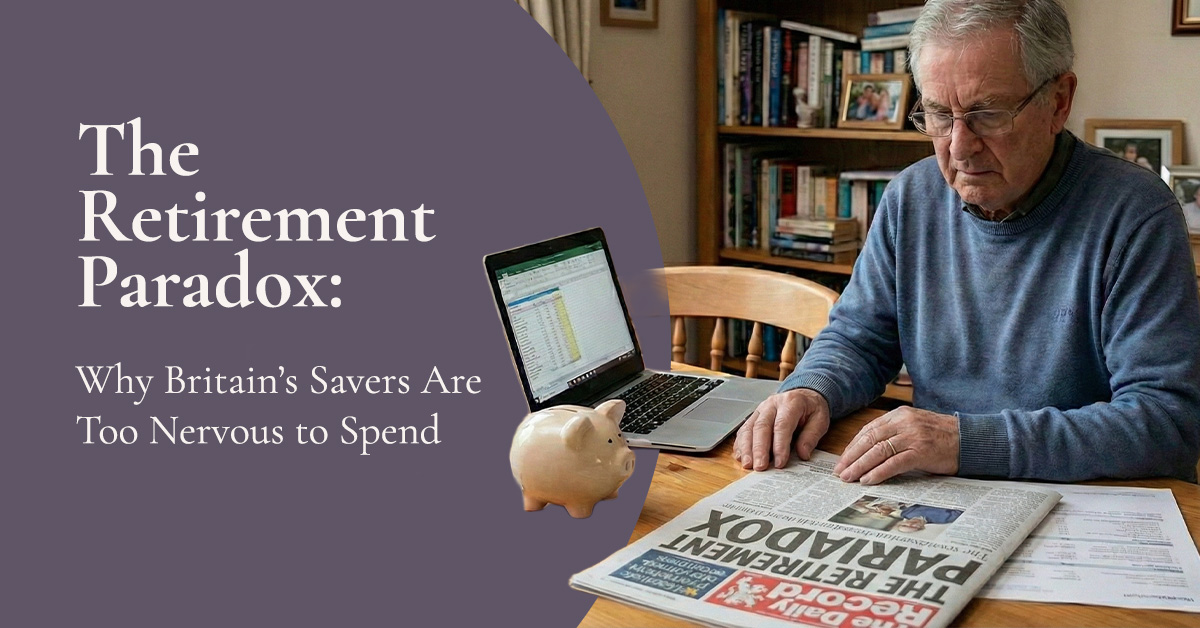
The Retirement Paradox: Why Britain’s Savers Are Too Nervous to Spend
Britain’s pension problem is normally described as a numbers problem: too little saved, too late. That is real. But there is another problem sitting alongside it — more psychological, and arguably more corrosive: even when people have saved enough, they no longer feel entitled to use it.
Read more
 Published On: December 11, 2025|4.3 min read|
Building Shock-Resistant Portfolios in an Era of Geopolitical Risk, Sanctions, and Inflation
Global uncertainty has become the norm. Trade tensions, inflationary pressure, sanctions, and shifting geopolitical interests now influence markets in ways not seen for decades. For internationally mobile professionals and high-net-worth families, the question is no longer if disruption will occur but how prepared your portfolio is when it happens.
Read more