
Governments like to give the impression that they are in control of the nation’s finances.
Budgets are delivered from the dispatch box. Chancellors announce what will be taxed, what will be spent and how their decisions will deliver growth.
But there is another participant in the room. It doesn’t stand for election, give interviews or make speeches.
The bond market.
And if you have a pension or investment portfolio, what happens there matters to you too.
When a government wants to borrow money, it issues bonds. In Britain, these are called gilts. You lend the government money for an agreed period and, in return, it promises to pay you interest and eventually return your capital.
It sounds reassuringly dull. It isn’t always.
Imagine you put £100 into a two-year investment paying 3 per cent. A week later, an identical investment becomes available paying 6 per cent.
There is nothing wrong with yours. You will still receive your 3 per cent and your £100 will still be repaid at the end. But if you wanted to sell it today, why would somebody give you £100 for an investment paying 3 per cent when they could get 6 per cent elsewhere?
They wouldn’t.
Your price would have to fall until the return available to the new buyer became competitive.
That is the seesaw at the heart of bonds. When yields rise, existing bond prices fall. When yields fall, existing bond prices rise.
And governments don’t just borrow once. They keep coming back.
A household that never clears the mortgage
Britain has accumulated a very large mortgage.
When old government debt matures, much of it is refinanced with new borrowing. More is added when government spending exceeds what comes in.
Think of a household with a large mortgage that reaches the end of its fixed term every few years. Rather than clearing it, the family refinances.
If rates have risen in the meantime, the old mortgage hasn’t changed. But the next one costs more.
Government borrowing works in much the same way. A move in gilt yields doesn’t suddenly change the interest rate on every bond already issued, but it does affect the price of the borrowing that comes next.
The bond market is constantly putting a price on what it will cost Britain to borrow. And eventually somebody has to pay it.
Borrowing itself isn’t necessarily a problem.
A family might borrow to extend a house and add more to its value than the work cost. A business might borrow to buy machinery that allows it to produce more.
Countries can borrow to build things that improve productivity and economic growth too. Done well, today’s borrowing can make tomorrow’s debt easier to carry.
But borrowed money can also fund today’s consumption.
I think of it as the difference between borrowing to buy tools and borrowing to buy sweets.
The sweets are enjoyable immediately. Everyone is happy for an afternoon. Then the sugar rush wears off and the debt is still there.
Bond investors care about the difference because they are the ones being asked to lend the money. If they become less confident about inflation, growth or the government’s finances, they can demand a higher return for doing so.
A Chancellor can decide what to spend. They cannot decide indefinitely what investors will charge to fund it.
Your pension may be lending to the government
When people imagine who owns British government debt, they often picture China, foreign governments or enormous sovereign wealth funds.
A great deal of it sits much closer to home.
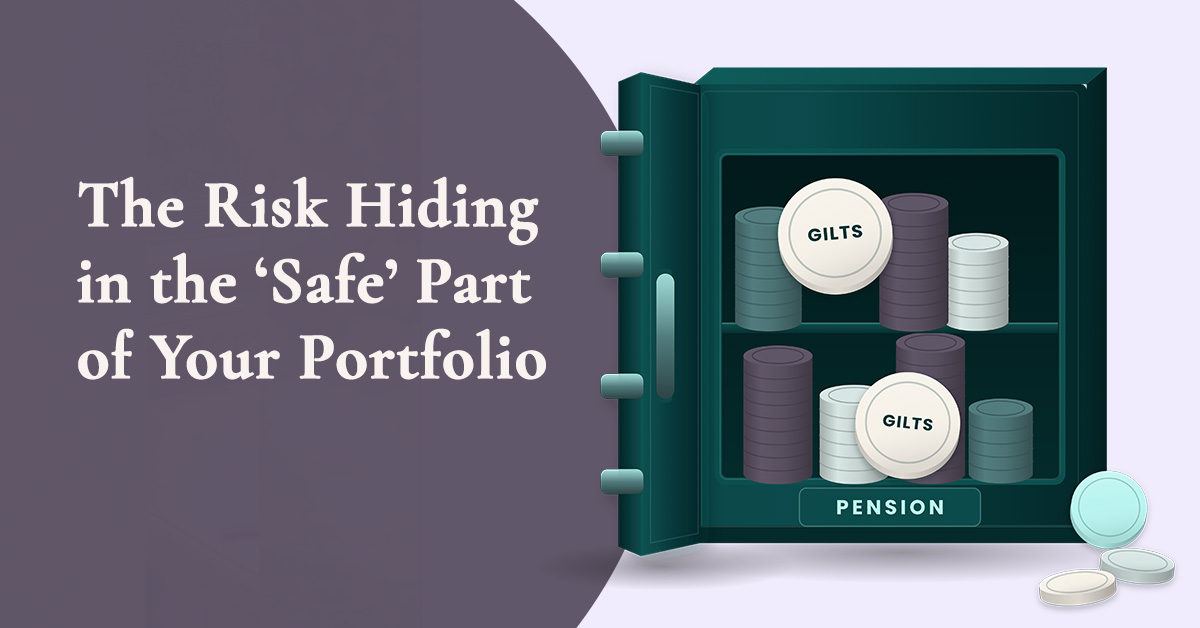
UK pension funds and insurance companies are significant holders of gilts, which means there is a good chance you own government debt without ever having consciously decided to buy it.
Look inside many workplace pensions, particularly as retirement approaches, and you will find bonds. They have traditionally been used as the supposedly steadier part of the portfolio.
And sometimes they are.
But “bond” is not another word for “safe”.
A short-dated government bond held until maturity is a very different proposition from a fund stuffed with long-dated bonds whose market value moves every day. The further away the repayment date, generally speaking, the more sensitive the price can be to changes in interest rates.
Investors were given a fairly brutal reminder of that in 2022. Inflation took off, interest rates rose, gilt yields climbed and bond prices fell. People who thought they owned the boring bit of their pension discovered that boring assets could produce decidedly un-boring losses.
That doesn’t make bonds bad investments. It makes the word “safe” a poor substitute for understanding what you actually own.
What is the money for?
This is the question I would rather investors started with.
Money needed for a house purchase next year and money intended to support a 30-year retirement may belong to the same person, but they are doing completely different jobs.
Cash gives you certainty over the number on the statement, but inflation can quietly eat away at what that money will buy.
Short-dated, high-quality bonds can be useful where greater certainty is needed over the next few years.
Long-dated bonds may offer an attractive yield, but their prices can move substantially when interest-rate expectations change.
Equities can be horribly uncomfortable over short periods but may be exactly where money intended to grow over decades belongs.
There is no universally safe asset. There is only an asset that is more or less appropriate for what you need the money to do.
That matters because investors spend an extraordinary amount of energy trying to predict what happens next.
Will interest rates fall? Will gilt yields rise? What will the Chancellor announce? Where will inflation be next year?
You can have a view on all of them. I certainly do. But I wouldn’t build a financial plan that only works if those views turn out to be right.
Money needed soon should not depend on markets behaving themselves. Longer-term money needs the opportunity to grow. Known future spending can be planned for rather than left to whatever markets happen to be doing when the bill arrives.
That is the point of financial planning. Not removing risk, as that is impossible — but working out which risks you can afford to take, which you cannot, and where.
The Chancellor may occupy Number 11. But when it comes to the price of borrowing, someone else gets a vote.
Benefit from comprehensive, integrated, and objective advice.
Let’s discuss your specific needs and how I can help you meet your objectives
Let’s start the conversation
Online enquiry form
Related posts
 Published On: September 11, 2026|7.9 min read|
Six Funds. One Portfolio. More Overlap Than You Think.
This is one of the things you notice when you spend enough time looking through investment portfolios. People often own the same companies far more times than they realise. It doesn't make those companies bad investments. It does mean the number of funds in your portfolio tells you almost nothing about how diversified you really are.
Read more
 Published On: June 24, 2026|6.6 min read|
UK State Pension Abroad: Frozen Pensions, National Insurance Changes and What Expats Need to Know
Recent changes to voluntary National Insurance contributions, frozen pension rules and the hidden risks facing expatriate families.
Read more
 Published On: May 26, 2026|4.5 min read|
Thinking About Leaving the UK? Why More Britons Are Reassessing Where They Build Their Future
More Britons are considering leaving the UK for financial reasons. Explore what's driving the trend and what to consider before relocating abroad.
Read more