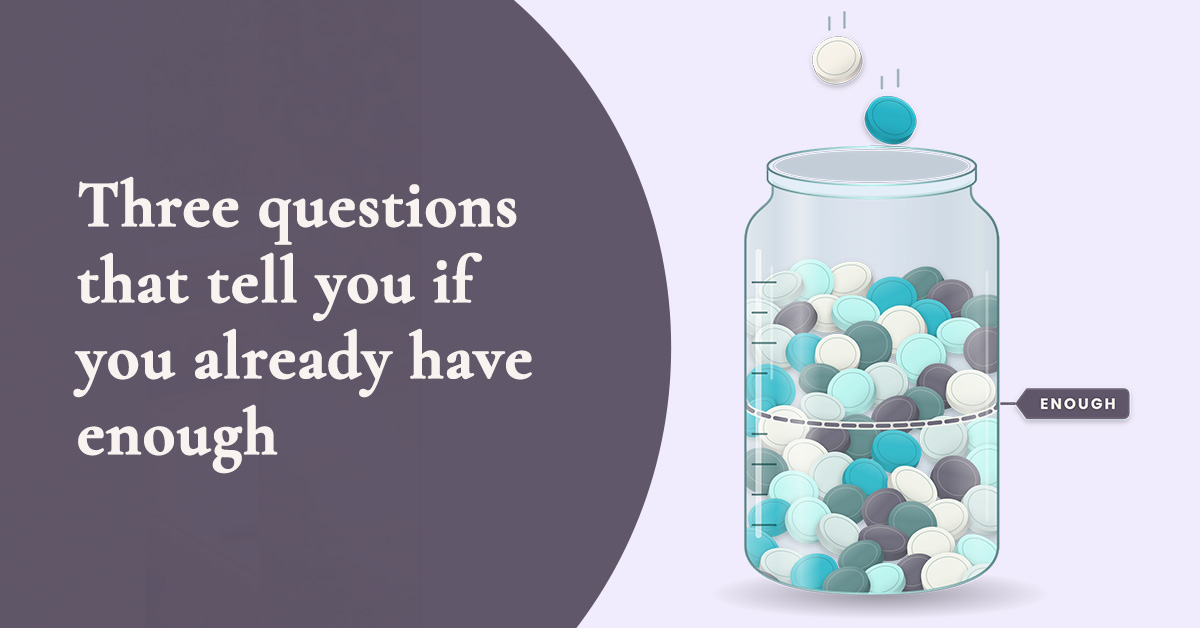
A financial plan has to get the numbers right. It also has to ask whether you’re still postponing a life you could already be living.
You can have a plan that looks perfectly respectable, and a year that looks much the same as the last one. The pension is in decent shape. The cash would have seemed impossible twenty years ago. Contributions go out on time.
The original work may have been done years ago, and the plan has kept going anyway. Contributions still leave the account. Cash still builds. The pension is still treated as something that must not be touched, even when the mortgage has gone and the children are no longer dependent. A figure for “enough” got chosen sometime in the forties and has not been looked at again, though the job may now be optional.
You still have to run the numbers properly. Stopping work at 60 only works if the money lasts. But running the numbers only tells you what you can afford. It doesn’t automatically change how you live. A plan can show that a different working pattern, a long stretch away, or starting to use the pension would hold. It cannot decide any of those things for you. This is why planning is never just about the numbers.
The part of the work that tries to get the life clear first is often called life planning. George Kinder, an American financial planner, gave it a method, and he has been teaching other planners to work this way for years. Most people know him for three questions. They are his, published by the Kinder Institute of Life Planning, and he means them to be answered in order, one at a time, without skipping ahead. Each one is tighter than the last.
He starts by taking money off the table. “Imagine that you are financially secure, that you have enough money to take care of your needs, both now and in the future. The question is: how would you live your life? Would you change anything? Let yourself go. Don’t hold back on your dreams. Describe a life that is complete, that is richly yours.”
The first question opens the life up. With money no longer the constraint, it becomes possible to describe a life that would feel complete, before anyone starts talking about contribution rates. On its own, though, the answer can still be a bit of a wish list. That is why he does not stop there.
Then he puts a time limit on a healthy life. “Now imagine visiting your doctor, who tells you that you have only five-to-ten years left to live. The good news is that you won’t ever feel sick. The bad news is that you will have no notice of the exact moment of your death. What will you do in the time you have remaining to live? Will you change your life, and how will you do it?”
This is usually where the picture narrows. What felt essential when time was unlimited often looks less so. What remains tends to be more specific, and closer in time, than the first answer. The financial question starts to change with it, from how to keep building the pot to whether the next few years are actually being used.
The last question is sharper still. “This time your doctor shocks you with the news that you have only one day left to live. It’s not about what you would do on that day. Notice what feelings arise as you confront your full mortality. Ask yourself: What did I miss? Whom did I not get to be? What did I not get to do?”
Kinder is not asking for a schedule for that day. He is asking what has been left undone, and who you did not get to be. The first two answers can still leave room to delay. This one is meant to make delay harder to justify.
Taken together, the questions are a way of getting to what the plan is actually for. You are not meant to average the answers, or tidy them into a list of goals for the next review. Each question is designed to get closer to what matters, and the later ones often show that some of the earlier dreams were not the point. What you are left with is usually clearer, and more urgent, than a target number on a spreadsheet.
That is the outcome that matters for the financial plan. Sometimes the life that remains is already affordable, which means “enough” arrived some time ago and the work is to start, not to keep adding. Sometimes it is not, and the value of the process is finding that out while the plan can still be changed: to start using some of the pension, or to put this year’s spare money towards the life you described rather than into another contribution. The numbers still have to stand it. If they can’t, you need to know. If they can, and you are still waiting, you need to know that too.
Benefit from comprehensive, integrated, and objective advice.
Let’s discuss your specific needs and how I can help you meet your objectives
Let’s start the conversation
Online enquiry form
Related posts
 Published On: October 5, 2026|4.9 min read|
Inheritance Tax: The Six-Month Deadline Families Often Overlook
Inheritance tax is usually due within six months, often before the house can be sold. How executors can pay it when the wealth is tied up in property.
Read more
 Published On: September 28, 2026|7.6 min read|
Your Pensions Don’t Know You Have Other Pensions
Most people collect several pensions over a working life, but none of them know the others exist. Why that's a collection of pots, not a retirement plan.
Read more
 Published On: September 18, 2026|5.4 min read|
The Risk Hiding in the ‘Safe’ Part of Your Portfolio
Your pension may hold more gilts than you realise. How the bond market prices government borrowing, and why "safe" is not the same as free from risk.
Read more